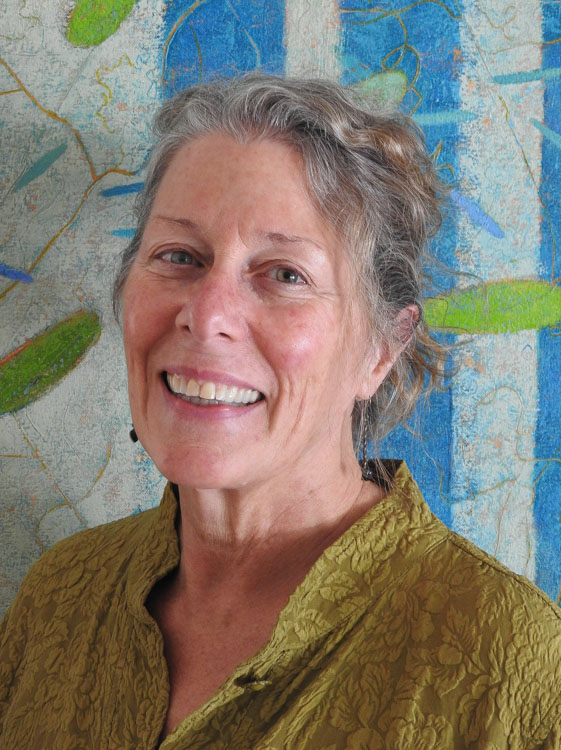
Katherine Steichen Rosing
Visual Artist
Katherine Steichen Rosing explores environmental issues and invisible forces in forests and watersheds through vividly-hued paintings, intricate mixed media works, and immersive installations.
Rosing earned an MFA in painting and drawing from Northern Illinois University, a BFA from the University of Colorado-Denver, and a BA from the University of Wisconsin-Madison. She taught studio art courses for over 20 years at colleges in Chicago and Madison, including Madison College and the University of Wisconsin-Madison.
Rosing’s work has been exhibited in solo and group exhibitions in museums and galleries across the United States and abroad, including the Museum of Wisconsin Art, the Rockford Art Museum, and the Saitama Modern Art Museum in Japan. Rosing’s paintings are included in many public and private collections internationally.
She is the recipient of numerous grants and awards, including the 2022 Forward Art Prize, the Madison Arts Commission/Wisconsin Arts Board Individual Artist Fellowship, and artist residencies at the UW-Madison Department of Limnology’s Trout Lake Research Station and the St. Croix Watershed Research Station, sponsored by the Science Museum of Minnesota. Rosing was born in Appleton and lives and maintains her studio in Madison.
What energizes you as you consider the future of the arts in Wisconsin?
The energy and work at the grassroots and local levels is incredible, despite the fact that Wisconsin’s per capita funding for the arts sadly remains at the lowest in the country. Organizations across our state, like Arts+Literature Lab in Madison, the Center for Visual Arts in Wausau, Women Artists Forward Fund in Dane County, and the Gener8tor Art program in Milwaukee are just a few of these critical organizations supporting artists and arts programming. Supported in large part by volunteers and private donations, they enrich local communities through exhibitions, performances, and classes.
It’s exciting to live in a place with a strong arts presence where there are stimulating activities that make the community a vibrant place to live and thrive. I respect and appreciate the Wisconsin Arts Board and applaud the 50 years of leadership that nurtures arts organizations across the state! I am hopeful that our state leaders will recognize both the economic value and the psychological value of a thriving arts community and raise arts funding to levels more closely aligned with the values of the people in our state.
What excites you as you make your work, and why do you make the work that you do?
I have a profound relationship with northern ecosystems and the deep forests and waters they envelop that began as a child camping in northern Wisconsin. I am obsessed with color and surface in painting and with creating immersive installations. Embedded in both practices are my experiences in the wilderness, experimentation in the studio, and scientific readings about environmental issues.
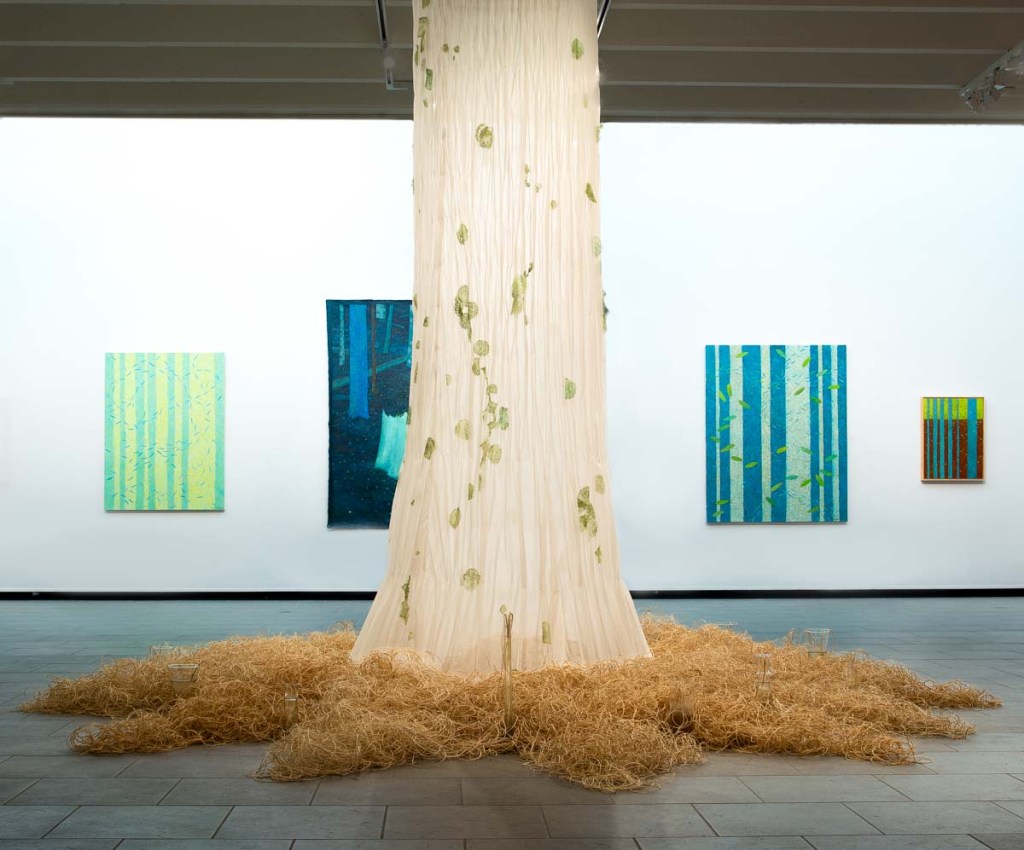
Painting abstractly is a way for me to examine and envision intricate relationships in natural environments. I work in many layers using acrylic paint to develop a complex surface. I often draw or scratch into wet paint, then apply new layers that may obscure the original marks. These implanted inscriptions may refer to invisible processes and life forms or may simply encrust the surface. The versatility and fast drying nature of acrylic make it ideal for these techniques. The paintings range in scale from quietly intimate to engulfing.
Forests are my lens to climate, invasive species, and ecological cycles, themes explored in my large-scale installations. Tree-scale suspended sculptures made from various lightweight collapsible materials provide an experiential space to contemplate invisible environmental processes and ecological issues. The delicate “spirit tree” fabric sculptures suggest the fragility of forest ecosystems. The trees are hand sewn, beaded, and embroidered along with other repurposed and recyclable materials. I treasure the partnerships that develop through these projects, ranging from research and dialogue to creative collaborations that enrich my perspective and expand the ecological dialogue.
Where can we find your work?
My website, https://www.studioksr.com is a great place to find images of my work and to learn more about my paintings and installations and my studio practice. My work is represented by Cappaert Contemporary in Egg Harbor and by Groveland Gallery in Minneapolis. I will have a solo exhibition in Milwaukee at James May Gallery in June 2024. For more nitty gritty insights into my studio work, follow me on Instagram, @KatherineRosing
 50 Years of the Wisconsin Arts Board